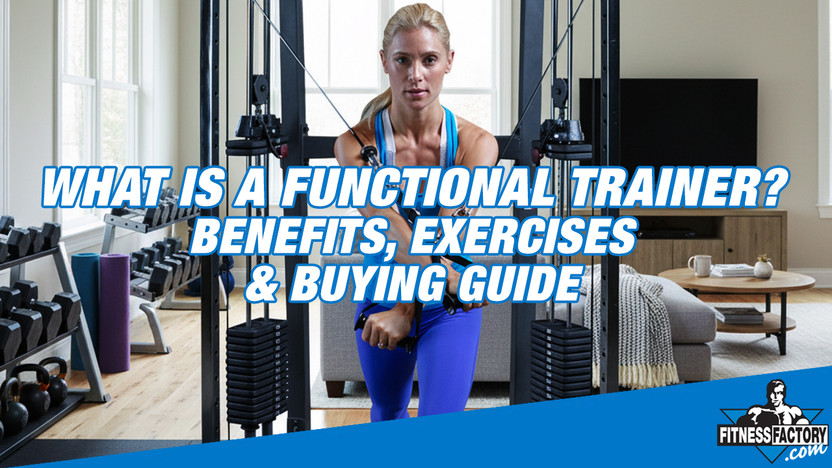
What is a Functional Trainer? Benefits, Exercises & Buying Guide
Posted by FitnessFactory.com on 02.12.26
When you step into a commercial gym, there is one piece of equipment that is almost always in use: The Functional Trainer.
But what exactly makes this machine so special, and why is it becoming the must-have centerpiece for home gyms and training facilities across the country?
Whether you are looking to build raw strength, recover from an injury, or improve your athletic performance, the functional trainer is the ultimate "Swiss Army Knife" of fitness—compact, powerful, and endlessly versatile.
In this guide, we'll break down what functional trainers are and how they work, explore the different styles available at FitnessFactory.com, and explain how to choose the right one for your space and goals.
What is a Functional Trainer?
A functional trainer is a cable-based machine that uses adjustable pulleys to provide a near-infinite range of motion.
Unlike standard weight machines that lock you into a fixed path (think of a seated chest press), a functional trainer allows for free-motion movement.
The cables move with you, allowing you to mimic real-life actions such as swinging a golf club, pushing a heavy door, or reaching for a high shelf. This engages your stabilizer muscles and simultaneously improves your balance, coordination, and core strength.
Functional trainers are popular in both commercial and home gyms for their unmatched adaptability and user-friendly design.
The Top 5 Benefits of Functional Training
So why do functional trainers deserve a spot in nearly every gym? They offer serious training benefits, support long-term health, and help you get the most out of every workout.
Here are five key benefits that make functional trainers a favorite for home and commercial gyms alike.
- Unmatched Versatility: Perform hundreds of exercises—pulling, pushing, squatting, lunging, and twisting—all in one compact footprint.
- Low Impact: The fluid motion of the cable system is gentle on the joints, making it a favorite for physical therapy and longevity-focused workouts.
- Space Efficiency: Instead of buying five separate machines, a single functional trainer handles your entire body.
- Safety: There's no risk of being pinned under a heavy barbell. If you hit failure, you let go of the handles, and the weight stack returns to its housing safely.
- Scalability: From professional athletes to beginners, anyone can adjust the height and weight to match their ability.
Which Type of Functional Trainer is Right for You?
Not all cable machines are created equal.
At FitnessFactory.com, we carry several configurations to fit your space and budget.
Each model has unique advantages depending on your training goals, budget, and available space. Our US-based fitness consultants are always available to help you make the right choice:
Cable Crossovers
The classic wide-frame design. Perfect for chest flies and wide-stance movements.
- Our Top Pick: Powerline PCCO90X
Dual-Column Trainers
Two independent pulleys that allow for bilateral training (working both sides at once) or independent movements.
- Our Top Pick: Body-Solid GFT100 or the space-saving Powerline PFT100.
Single-Stack/Single-Column
If you're tight on space or focusing on unilateral (one-arm) work, these are highly effective and budget-friendly.
- Our Top Pick: Best Fitness Functional Trainer.
Understanding Functional Trainer Weight Ratios and Their Importance
A weight ratio on a functional trainer is the relationship between the weight selected on the weight stack and the actual resistance you experience during an exercise. This resistance is influenced by the pulley system that guides the cables.
Here's a breakdown of the most common weight ratios:
1:1 Ratio
In a 1:1 weight ratio setup, the cable passes through a single pulley before reaching the handle. Thus, if you select 50 pounds on the weight stack, you will feel 50 pounds of resistance when pulling or pushing the handle.
This ratio is ideal for exercises that require heavy resistance and controlled movements, such as biceps curls or triceps extensions.
2:1 Ratio
With a 2:1 ratio, the cable goes through two pulleys before reaching the handle. In this case, if you select 50 pounds on the weight stack, you will only feel 25 pounds of resistance.
The advantage of a 2:1 ratio is that it allows for faster cable movement and a greater range of motion, making it suitable for functional training exercises such as lunges, rows, and overhead presses.
Examples of functional trainers with a 2:1 weight ratio include:
Other Functional Trainer Weight Ratios
Some functional trainers have even higher weight ratios, such as 3:1 or 4:1.
For example, the Powerline by Body-Solid PFT50 Functional Trainer has a 4:1 ratio.
These higher ratios are particularly advantageous for exercises that demand speed and agility while further reducing the perceived weight.
Choosing the Right Weight Ratio
Selecting the correct weight ratio depends on your fitness goals and the types of exercises you plan to perform. If your primary focus is strength training, a 1:1 ratio may be more beneficial.
However, if you are concentrating on functional training and enhancing your movement patterns, a 2:1 ratio or higher might be more appropriate.
What exercises can you do on a functional trainer?
A standard functional trainer allows for a wide variety of exercises, opening up hundreds of training possibilities. Whether you're aiming to build strength, improve balance, enhance mobility, or train sport-specific movement patterns, the adjustable pulley system gives you the freedom to train in every direction. It’s one of the only machines that can hit every major muscle group, often in a single workout.
Here are some examples of the most effective exercises you can perform on a functional trainer:
- Chest Press: This classic exercise targets the chest by facing the machine and pushing the handles away from you.
- Cable Fly: This exercise also targets the chest muscles by bringing the handles together in front of your chest.
- Incline Chest Press: By setting the pulley at an angle, this variation targets the upper chest muscles.
- Seated Cable Row: This exercise focuses on the back muscles as you pull the handles toward you while seated.
- Lat Pulldown: This move targets the latissimus dorsi (lats) by pulling the bar down towards your chest.
- Single-Arm Cable Row: This variation works one side of the back at a time for a more focused workout.
- Overhead Press: This exercise targets the shoulder muscles by pushing the handles overhead.
- Lateral Raise: This targets the deltoid muscles by raising the handles to the sides.
- Front Raise: This exercise targets the anterior deltoid by raising the handles in front of you.
- Squat: This compound exercise engages the quads, hamstrings, and glutes. You can perform squats on a functional trainer by holding the handles and squatting below parallel.
- Lunge: This exercise also targets the quads, hamstrings, and glutes. You can do lunges by holding the handles and stepping forward with one leg.
- Cable Trunk Twist: This exercise targets the core muscles by resisting rotation as you press the handle away from you.
The examples above represent just a small selection of the many exercises and movements you can perform on a functional trainer.
For even more exercise ideas, watch the video below!
Let us help you find the perfect functional trainer for your space and goals!
Investing in a functional trainer is a step toward better long-term health.
When shopping for one, consider the build quality, stability, and smoothness of the pulleys. It's crucial to find a machine that feels just as sturdy on the 1,000th rep as it did on the first.
Visit FitnessFactory.com and use the live chat feature to connect with one of our US-based fitness consultants today.
Alternatively, you can call us at (800) 383-9300 to speak directly with a consultant who will help you find the perfect functional trainer to fit your needs, space, and budget.
If you're in the Chicagoland area, stop by our showrooms in Aurora and Forest Park to test out functional trainers in person and get expert advice.