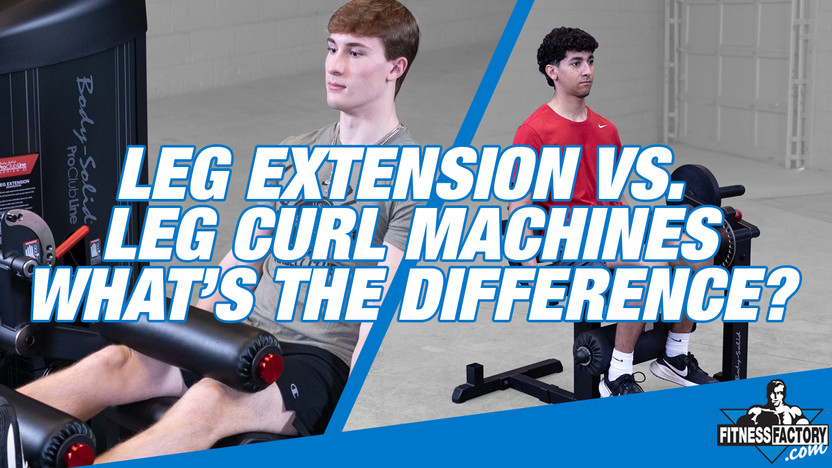
Leg Extension vs. Leg Curl Machines: What’s The Difference?
Posted by FitnessFactory.com on 06.25.26
When it comes to building a powerful, well-rounded lower body, compound movements like squats and leg presses usually steal the spotlight.
If you want to sculpt specific muscle groups, correct muscular imbalances, or safely protect your knees for the long term, isolation machines are the tools for the job.
Two of the most popular isolation tools in both commercial and home gyms are the leg extension machine and the leg curl machine.
While they might look similar at a glance, both featuring padded rollers and a seated or lying position, they perform opposite functions and train completely different muscle groups. Knowing the differences helps you train more intentionally, whether you are filling a gap in a home gym setup or deciding between machines at a commercial facility. Here is how they compare.
Which Muscles Does Each Machine Target?
The primary difference between these two exercises is which side of your leg you are training.
The Leg Extension Machine: Quadriceps
The leg extension is an anterior (front-of-the-body) exercise designed to isolate your quadriceps: the rectus femoris, vastus lateralis, vastus medialis, and vastus intermedius. Every time you straighten your knees against resistance, your quads are doing 100% of the work.
Because it works the quadriceps, a leg extension machine is especially useful for anyone rehabbing a knee injury under a physical therapist's guidance, building the teardrop muscle near the knee for aesthetic reasons, or addressing quad weakness that causes knee tracking problems during squats.
The Leg Curl Machine: Hamstrings
The leg curl is a posterior (back-of-the-body) exercise engineered to target your hamstrings: the biceps femoris, semitendinosus, and semimembranosus. When you pull your heels toward your glutes, your hamstrings contract powerfully.
Strong hamstrings are a direct injury prevention factor. The hamstrings act as the primary check against excessive forward knee movement, which is the mechanism behind a significant portion of non-contact ACL injuries. Leg curl work is not optional for anyone who squats, runs, or plays sport.
Leg Extension vs. Leg Curl: How the Movement Differs
The mechanical movement pattern of your knee joint dictates which machine you need:
Leg Extension (Knee Extension)
You sit with your back supported, place your shins behind a padded roller, and extend your legs forward until they are completely straight. This movement zeroes in on the quad sweep and the teardrop muscle near the knee, building stability around the joint.
The seated position and fixed range of motion are limitations by design. By anchoring your hips and back, the machine eliminates momentum and keeps the workload entirely on the quad, which is exactly what isolation training requires.
Featured Equipment: For commercial facilities or dedicated home gym lifters who want a standalone selectorized unit, the Spirit Commercial Strength Leg Extension Machine provides a smooth, guided path of motion that keeps continuous tension on the quads throughout the full range.

Leg Curl (Knee Flexion)
To target the hamstrings, you flex the knee against resistance. Leg curls come in three configurations: seated, prone (lying face down), or standing.
Each position hits the hamstrings at a slightly different angle. Prone curls emphasize the biceps femoris and allow a longer range of motion. Seated curls keep the hip flexed throughout, which pre-stretches the hamstring and can increase activation in the semitendinosus. Standing curls isolate one leg at a time and are common in rehab settings. Most home gym buyers will find a seated or prone unit covers the vast majority of their needs.
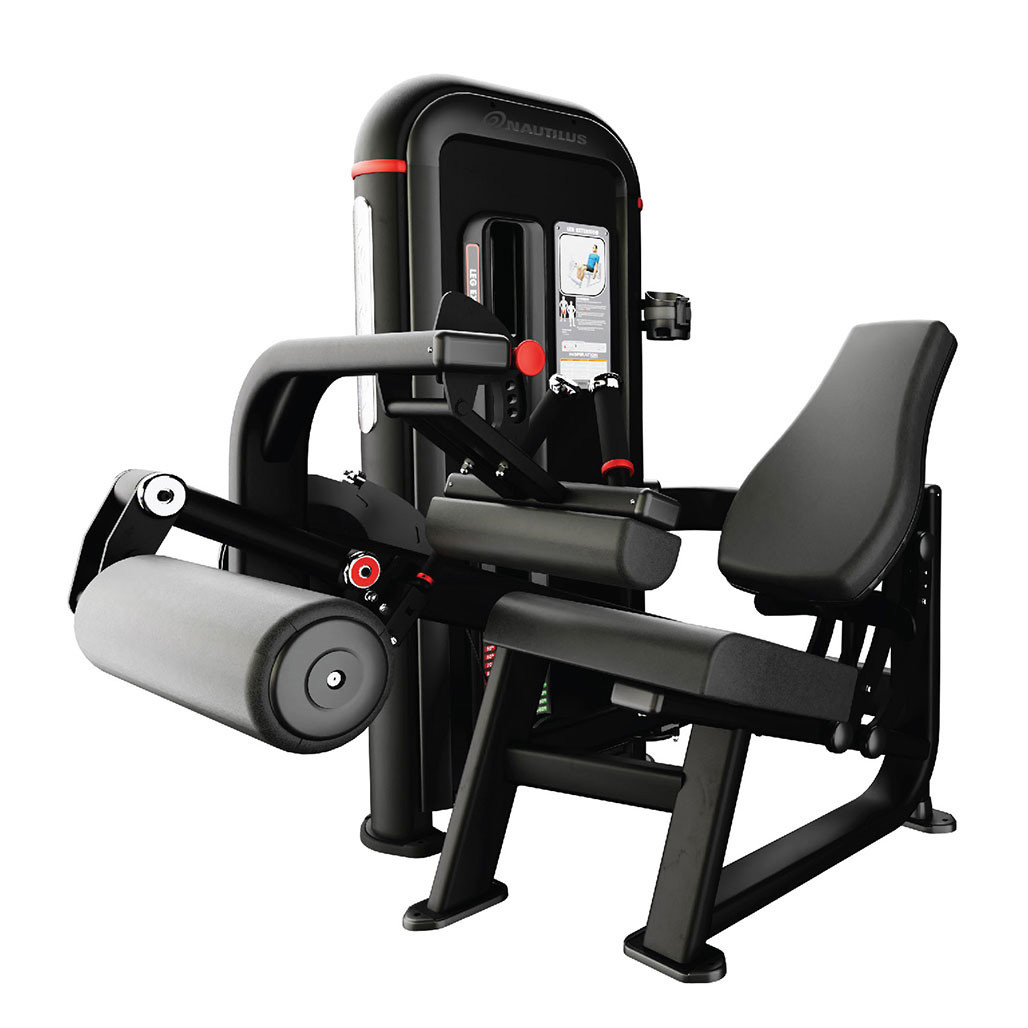
Featured Equipment: For prone training that maximizes hamstring isolation and eliminates lower-back momentum, the Spirit Commercial Strength Prone Leg Curl Machine is purpose-built for the position. For seated training, the Nautilus Seated Leg Curl Machine locks the thighs in place for a secure, controlled contraction.
Space-Saving Leg Machines for Home Gyms
For a home or garage gym, buying two commercial-grade standalone machines is not always practical. Space and budget both factor in.
The good news is that you do not have to choose between training quads and hamstrings. Dual-function combo machines solve this directly, and several strong options exist at different price points.
Engineers have designed dual-function combo machines that let you transition from extension to curl by adjusting a pin or pad position, with no equipment swap needed.
Pro ClubLine Series 2 Leg Curl and Extension Machine
This machine carries a commercial weight stack and advanced ergonomics, delivering two full isolation movements in a single footprint. It is the right call for lifters who want commercial-grade performance at home without buying two separate machines.
Plate-Loaded Combo Machines: Body-Solid and Powerline
If you prefer using your own Olympic weight plates, the Body-Solid CAM Leg Extension Leg Curl Machine and the Powerline Leg Curl and Leg Extension Machine are strong options at different price points. Both use a revolving cam system to align your knee joint with the machine's pivot point throughout the movement, which protects the joint and keeps the workload on the target muscle.
The Body-Solid CAM unit is the more robust of the two, with a higher weight capacity and heavier construction. The Powerline version is a practical starting point for lifters building a first home gym on a tighter budget. Both have been in FitnessFactory.com's catalog for years and hold up well under regular use.
Leg Extension vs. Leg Curl: Which One Does Your Training Need?
The short answer: both.
An imbalance between your quads and hamstrings is one of the leading causes of knee pain and athletic injuries, including ACL tears. If your quads are significantly stronger than your hamstrings, the knee joint operates under unequal tension with every step, squat, and jump.
Healthy knees depend on a meaningful strength balance between your quads and hamstrings. Most recreational lifters fall short of it. Quad-dominant movements like squats, leg presses, and lunges show up in almost every lower-body program, while dedicated hamstring work gets skipped. Adding a leg curl to your routine addresses that gap.
By incorporating both leg extensions and leg curls into your routine, or investing in a combo machine from FitnessFactory.com's leg machines collection, you train for symmetrical muscle development, healthier joints, and more balanced lower-body strength over time.
What Buyers Say About Leg Machines
Feedback from FitnessFactory.com Customers
Customers who add a leg extension and curl machine to their home gym consistently report that it fills a real gap in their lower-body training. We’ve heard from many verified buyers about the specific leg machines featured in this post.
On the Body-Solid CAM Leg Extension Leg Curl Machine:
"Two years of heavy use and still just as solid and smooth as the first day. If you are thinking of adding this piece of equipment to your home gym, I would highly recommend it." -- Verified Buyer, Body-Solid CAM Leg Extension Leg Curl Machine
"Nearly as good as the $1,500 commercial one at the gym. Smooth and very stable. I like the seated leg curl better than lying down too." -- Verified Buyer, Body-Solid CAM Leg Extension Leg Curl Machine
On the Powerline Leg Curl and Leg Extension Machine:
"This is a good leg machine for the money. The angles are perfect for leg curls and the machine is relatively compact. For leg extensions, it is pretty good as well." -- Verified Buyer, Powerline Leg Curl and Leg Extension Machine
On the Body-Solid Leg Extension and Curl Machine:
"Great machine to isolate quads and hamstrings. Good back support." -- Verified Buyer, Body-Solid Leg Extension and Curl Machine
Shop Leg Machines at FitnessFactory.com
Browse the full selection of leg machines at FitnessFactory.com, including standalone leg extension machines, leg curl machines, and dual-function combo units. Free shipping is included on all orders.
If you are not sure which setup fits your space and programming, our US-based consultants can help. Reach us by live chat at FitnessFactory.com or by phone at (800) 383-9300.
If you're in the Chicagoland area, visit our showroom in Forest Park to test these machines in person before you buy.